

The Wrong Question
An early Easter reflection about what is most important

He is risen.
It is early Easter morning, and I woke before the sun and found myself thinking about salvation.
Some months ago, I returned home—to the town where I was raised. I returned because that is what sons do.
My return was to attend a sober event—a gathering populated by aging and wrinkled characters and heroes from my childhood. I went because my parents, long now passed, couldn’t. I attended because I needed to say my good-bye.

At the reception that followed, I eased—somewhat self-consciously—through the mingling throng in the foyer. When many in this gathering best knew me, I was but a boy: skinny and awkward. I have memories of eating at their dining tables, of running past them at church picnics, of being hushed away so they and my parents could continue their evening Bible study uninterrupted.
I met one set of eyes, softened by the decades, and we recognized each other immediately. It is funny—my memory is of a towering man, both in stature and in personality. Now I stand many inches taller, and he now frail.
We hugged.
Greetings quickly passed, and his eyes became serious and sad, brow furrowed and lips pursed. “Tony,” he began in a way that begged me to lean nearer…
“Tony, do you… do you know the Lord?”
He could just as easily have slapped me across the face.
There are some of you who read that short story and it makes perfect sense. Others may have found it odd, but the terms and circumstances ring true. Still others may be confused.
It’s alright.
Let me explain a couple of things.
First of all, in the religious family of my youth, the question “Do you know the Lord?” is the question. It is everything. In that world, it contains the meaning of—but is not limited to—questions like: “Have you received Jesus as your personal Lord and Savior?” “Are you 100% sure that if you were hit by a bus (why is it always a bus?) you would go to heaven?” and “Do you adhere, without wavering, to the dogmas and doctrines of the faith?”
That last one is particularly tricky, isn’t it? Which dogmas? Which doctrines? Which faith?
Secondly, I want you to know that this laudable man had watched me through much of my formative years—seen me racing through the hallways of our old brick church and disrupting Sunday service from the back row of the balcony. He had watched me stand fast and tall for the church’s Bible quiz team, sing in sacred choirs, and perform in Christian dramas. He witnessed me recite innumerable Bible verses from memory, volunteer at church camp, and was probably even there to witness my baptism. He knew me… didn’t he?
Standing in that foyer, absorbing his “slap,” I was rushed by conflicting emotions. I was reminded of my deep love for the man—maybe even more so now, his countenance frailed by time. I wanted to answer honestly, and the pause was palpable as I searched my heart for how to respond authentically in the affirmative. I also wanted to reassure the saint before me and not cause him any undue sorrow.
“Yes,” I said. “I believe I do know the Lord.”
“Are you sure? Are you sure, Tony?” he begged, his eyes beginning to well with tears.
“Yes, sir. Yes, I believe that I know the Lord.”

His shoulders immediately softened, and the tension drained from his face, replaced by a smile of relief and wet streaks down his cheeks. He gripped my arms in each of his spotted hands, looked up at me, and said, “I am so happy. I am so happy. Because so many people think that you don’t.”
This man—this giant of my youth—was speaking “don’t” on behalf of the world that I grew up in. The “so many people” would come from an anthology of formative faith voices: pastors, Sunday school teachers, Awana club leaders, camp directors…the church that supported me well into my adulthood.
And yet, this chorus of doubt did not surprise me.
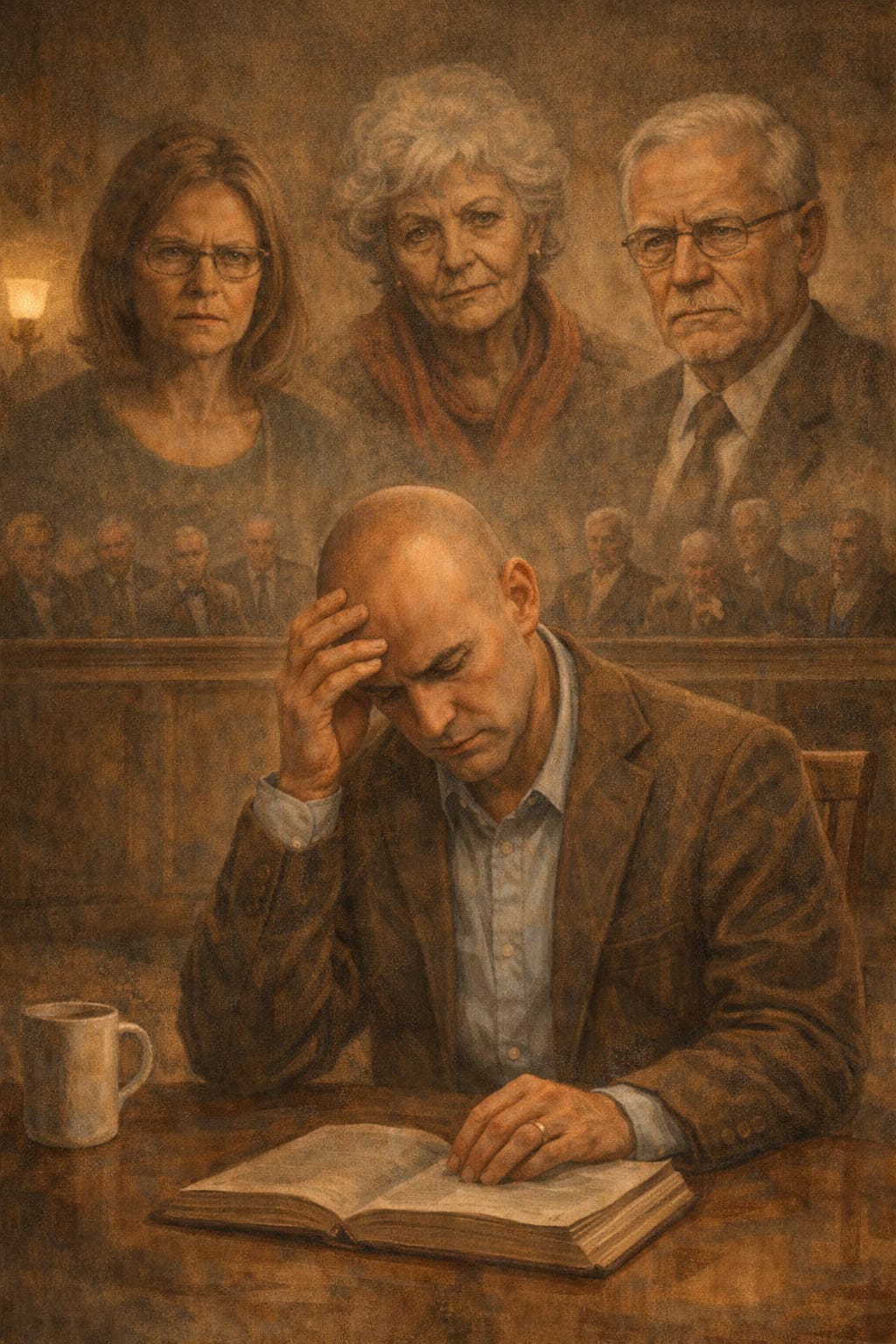
In recent years, I have had a Christian mentor from my college years sit at my dining room table before a sumptuous meal and tell me she didn’t think I was “saved” because she did not like the way I framed certain theological answers. I had a missionary hero from my years in Eastern Europe tell me she would never trust me because I had lost my way. And I had a “Mount Rushmore” person in my life suggest, in no uncertain terms, that I had lost my faith.
Like I said, it didn’t surprise me.
However, on this Easter morning, it is in fact an important question to ponder: “Do I know the Lord?”
If the question is, “Have I received Jesus as my personal Lord and Savior?”—well, to the doddering man in a church foyer, the answer is “yes,” most assuredly “yes.” It would be unloving to burden him with nuance or the perspectives afforded me by living in a dozen cultures and the tutelage and corrections I’ve received from women and men of divergent vantage points.
However, here, with you, my friend… the answer is probably “no.”
“Have I received…” What? An arbitrary set of words, spoken like an incantation, that is supposed to afford me some eternal safety net? An incantation, by the way, that over the course of my life has had an astronomical failure rate. If I were to parade the cacophony of other children the foyer man watched cycle through my church’s youth group, ask them today and hold their faith up to the light, how many of them would still hold to Christian fidelity?
“Have I received Jesus…” Which Jesus? Certainly not the religious construct of my youth—sanitized and hijacked by Western culture and turned into a mascot that bows to the theology du jour and elevates those who look like me, spend like me, vote like me, read like me, and worship like me.
“Have I received Jesus as my personal…” I don’t even know where this “personal” idea came from. Western individualism? John Wayne? Cogito, ergo sum? The scriptures speak of communities above individuals. The commands of the New Testament are manifestly directed to “y’all,” not “you, individual.” And, I’m sorry, but “For God so loved the world…”
“Have I received Jesus as my personal Lord…” Lord would mean that I am fully submitted to Jesus, surrendering at every turn to what my Lord desires over my own desires. On this, my answer is a resounding “no.” By any measurement of my life, the answer is “no”: my spending habits, my time management, my priorities, my addictions—even my “virtues.”
“Have I received Jesus as my personal Lord and Savior?” This is a hard one. What is Jesus saving me from, and what is He saving me to? This question is still very much a meditation in motion.
On this Easter morning, my “yes,” “no,” or even “maybe” may be missing the point entirely. Forgive my naïve simplicity, but today I don’t accept the premise of the question. I am not even sure the question is very meaningful to me anymore (acknowledging that I am mournfully adding fodder to the case against me by the pastors, mentors, Sunday school teachers, heroes, and Mount Rushmore figures of my past).
If the foyer-man’s question is not the point, then what is meaningful?
Now, today, on this Easter morning, if you want to meet me in the foyer and stand together—and if we want to ask each other, “Does the Lord know us?”—now that is a very interesting question.
Wow Tony! I’m pondering this for the rest of this Easter afternoon. Happy Easter to you and yours!
I sure love you!